Not even the first rays of sunlight have appeared when we’re already getting into the 4×4. We’re ready for a new adventure, there’s no doubt about that. Everything was prepared the night before. Tension slowly builds and seeps into the atmosphere. Moments of silence, of stillness.
A gravel road. We are in Sabanas de Acosta, Costa Rica. I try to calculate how far the nearest paved road is… Probably more than an hour away. Without a doubt, we’re deep in the most authentic part of Costa Rica. Forgotten by mass tourism, but no less beautiful for it. As we cross winding, steep paths, the first light of day offers us a unique view—we can see the Pacific Ocean! What a marvelous place.
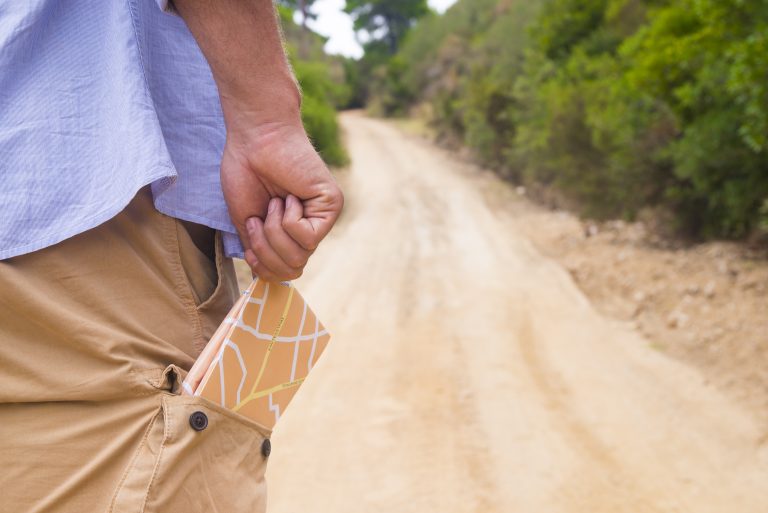
We’ve reached the point on the trail we were aiming for. It’s time to stretch our legs, crossing several farms and rivers to reach the beginning of our objective. Days before, we had studied everything using topographic maps and our beloved “trained dove” (the drone). We captured an image of the waterfall known as La Novia (“The Bride”)—massive and emerging from the thick vegetation. From the moment we saw her, it felt like she was calling to us. Never before descended, she would mark the starting point of our exploration.
The narrow paths we follow are zigzagging. Surrounded by lush trees over 30 meters tall, a play of light and shadow accompanies us throughout the day. The roots of the trees—larger than anything I’ve ever seen—form natural steps that make the climb easier. The songs of early birds mix with the constant hum of crickets, frogs, and small lizards fleeing our presence, rustling the fallen leaves. Soon the trail disappears, and we often have to rely on instinct alone to guide us.
It’s interesting how your senses sharpen. The sound of water always soothes us—for us, it means home.
Venturing deep into the Central American jungle makes you feel cornered by life in its wildest form. The sounds, blended with the scents, make you feel small. Every few steps you have to breathe and wrestle with your mind: “Everything is fine, you are strong.” Deep down you know that’s not true. With every meter, you feel eyes watching you. I don’t know exactly who or what, but I have no doubt the jungle is aware of every step we take.
This is the most biodiverse country on the planet, home to the largest variety of venomous snakes in the world. Which keeps you in a constant state of alert. To scare them off, we whistle and make noises as we move. We don’t know if it’s truly effective, but it helps keep the mind busy.
We descend steep slopes—over 80 meters—to reach the river. The number of live trees makes the task much easier. We rappel down using their beautiful trunks—many of which are so thick that even two people couldn’t wrap their arms around them. The descents take us through completely virgin and unexplored terrain, filled with branches, vines, leaves, and roots… that sometimes seem to come alive, grabbing at us like tangled nets. The backpacks make passage even harder; many times, it’s easier to lower the pack first, then yourself. The person going first is key, using a small machete to clear some of the vegetation.
No human has ever passed through here. Everything is wild and untouched. Most of the time, we can’t even see where we’re descending—we follow the sound of water.
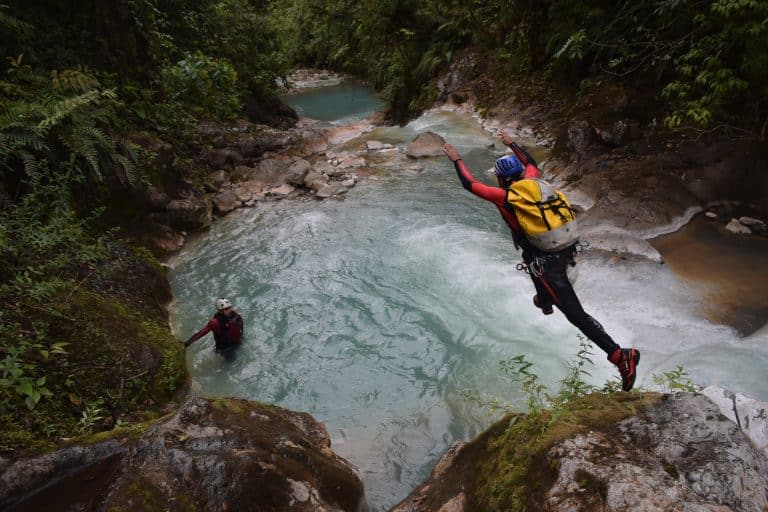
After several rappels from tree to tree, we finally step into the river. The first feeling is always one of calm. We’ve arrived. We pause to hydrate and refuel. Then we gear up with the rest of our technical equipment. It’s time to begin following the river’s course. Before starting, I like to take a few seconds to touch the flowing water—a ritual of sorts, as if asking permission to enter. In that moment, I’m reminded once again of our vulnerability, of how we’re surrendering to the power of nature.
After walking over giant boulders, we reach our first descent: La Novia Waterfall. The opening begins. We don’t know its total height, only that there’s a large ledge halfway down. It turns out to be 125 meters tall.
We are in the heart of the Central American jungle—a tropical forest bursting with life. We stumble often, constantly looking up while walking through the river. It’s hard not to be mesmerized by such natural beauty. Green dominates the entire descent, painting the whole landscape—from the rocks we step on to the trees sprouting where the canyon’s waters flow. Everything around us is green—green that climbs until it meets the blue of the sky. After several technical rappels (15 to 20 meters), downclimbs, and water crossings, we reach the final rappel: 65 meters, cascading into several small pools—now named Las Marías.
We keep walking and soon meet the main river. We’ve reached the end. All that remains is to follow the trail running alongside the river until we reach the gravel road.
After more than 9 hours of activity, the canyon is opened. We name it “Cañón Huesca”, as a tribute to our roots.
A meaningful gesture—after over a year guiding people from the depths of Costa Rica’s waters to its highest peaks. A small way to leave a mark of the love I feel for its nature and its people, who have surrounded me during all this time.
Forever grateful,
Pura Vida.